| ABOUT US|
We are the lightkeepers, the 3rd group from the class of ONL 10-1. Our purpose is to bring light to and uncover the mysteries left in the dark. We specialize in true crime cases, bringing attention to details most miss.
| PLATFORMS |
Find us on TWITCH at (@username)
Find us on INSTAGRAM at (@username)
Find us on TIKTOK at (@username)
...
Want to join the spotlight? Sign up to get a front row seat at (https.websiteurl.com)
...
| WHERE TO CATCH US? |
Join in on the mysteries...
- Monday and Saturday
- 4:00 to 6:00 pm (PST/PHT)
on TWITCH !
| COMMONLY ASKED QUESTIONS (our outline) |
1) How long are our streams? - Our streams usually last 1 to 2 hours long. This time frame is convenient for our members and is most suitable for our topic. We aim to maximize our productivity and time in discussing our topic.
2) What do we want to happen in our streams during the duration we set? - We aim to discuss and analyze true crime cases, share personal thoughts and opinions, and engage with our viewers.
3) What is our content? - Our content will be true crime podcast discussions.
4) How do we want our content to run in our streams? - We want our content to be the main spotlight and focus of our stream. Our aim is to make sure that our content is planned and runs smoothly. We also want to ensure that our viewers will be able to tell what our content is by looking at the design of our stream.
5) Will we hold discussions? - Yes, we will hold discussions about true crime and related topics during our investigations.
6) Will we talk to our viewers while we stream? What are the topics that we will talk about? - Yes, we will talk to our viewers by answering questions and encouraging the sharing of thoughts and opinions. The topics we will discuss include true crime cases, investigations, and forensic analysis.
7) Will we change our content in the middle of the streams? If yes, what are we planning to replace it with? - There is a possibility for us to change or make minor adjustments to our topic in certain conditions. If we are still not done with a topic we have already started, we will finish and conclude it before opening a new one. If viewers request a change or we finish the discussion of a certain topic early, there is a chance that we will initiate a new discussion about a similar case that is not far off from our main type of content.
8) How will we interact with our viewers? - We will interact with our viewers through making use of live chat, hosting question and answer sessions, creating polls, and including our viewers in discussions. We'll make sure to acknowledge the comments of our viewers and respond to their questions. We will encourage everyone to share their opinions or theories throughout the stream. Interacting with our audience will play a big role in keeping the audience involved, interested, and active.
9) Will we be using our audio for the entire duration? - Yes, we will use our audio for a majority of the duration unless there is a technical issue involved or our members are simply taking a break. Having audio on a majority of the time helps us to maintain a steady connection with our audience and keeops the stream more personal and engaging. If any sudden issue arises, we will make sure to commiunicate and inform our viewers as soon as possible and fix the issue in the shortest possible time frame.
10) What will appear on our screen for the entire duration of our streams? - We will be using our overlay and display images and videos related to the true crime cases such as case files, photo and video evidence, crime scenes, and suspect profiles.
11) Will we change overlays every hour? - We are aiming to stick to our main overlay, but will change it when convinient or to keep our content fresh and engaing.
12) Will we have a break? - Yes, a short 5 to 10 minute break should be enough to grab a snack, answer urgent messages, or simply rest.
13) Is there a video we want to play while we are streaming? What are those? Do we own the video? If not, does it follow the Digital Millenium Copyright Act (DMCA) guidelines? - We will play videos related to our true crime cases such as evidence and footage. As of the moment, we don't have any specific videos in mind, but we will immediately check if it fits the DMCA guidelines when we do.
| WHAT IS OUR SPECIFIC SCHEDULE? |
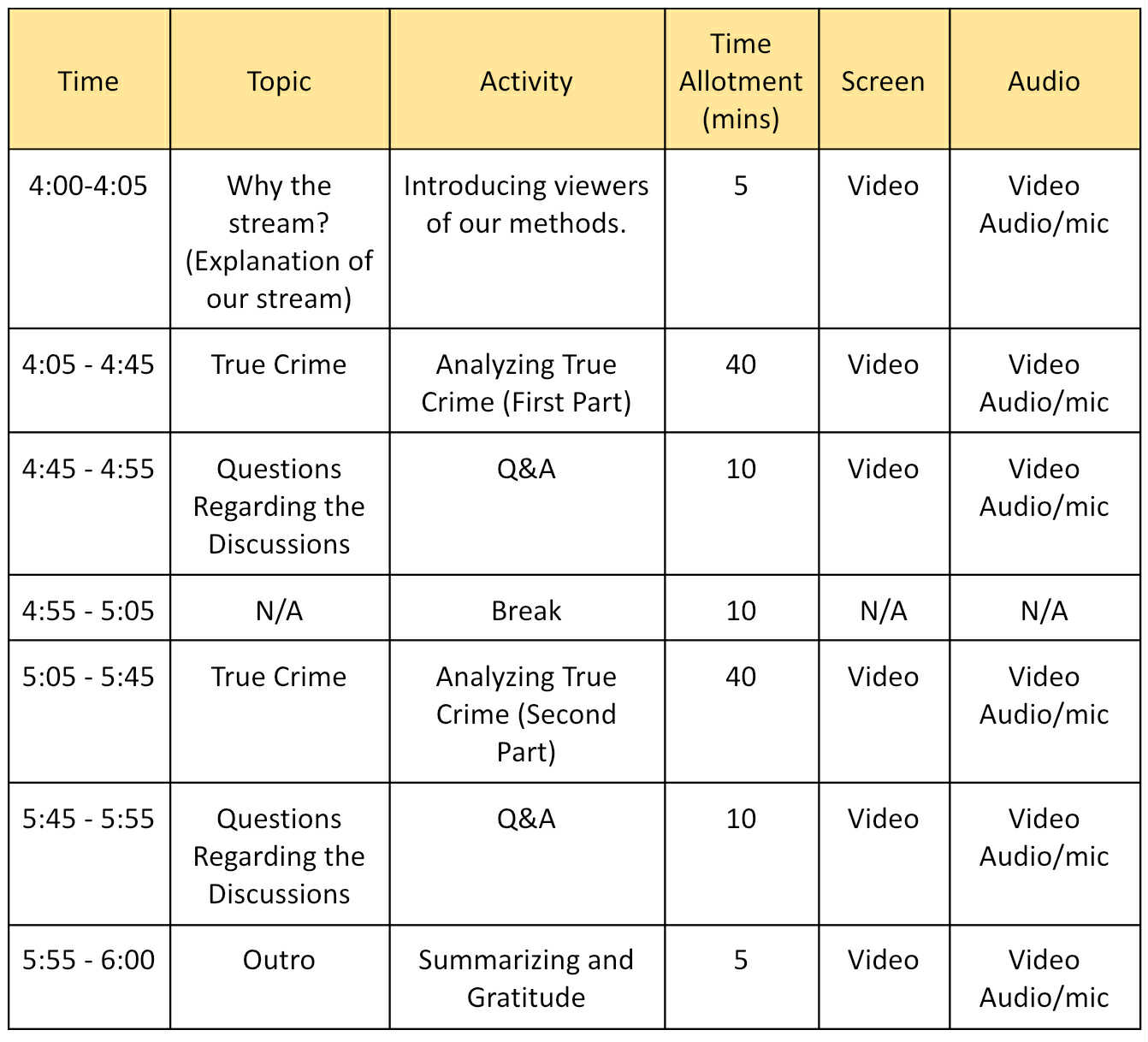
Our streams are consistently scheduled during MONDAY and SATURDAY every week, usually around the times of 4:00pm - 6:00pm. Each stream lasts around 2-3 hours with scheduled plans and events. Although, the streaming time may be increased or decreased based on certain situations. Each stream has 10-15 minute breaks for both the members and the audience.
The members have collectedly put together and decided that this schedule works the best and is most convinient for everyone.
| PROMOTIONAL PLAN AND MATERIALS |
OBJECTIVES:
Our objective is to promote both our stream and our website. We aiming to not just promote, but relate to our audience and their interests in order to capture their attention.
TARGET AUDIENCE:
Our target audience are viewers who are interested in true crime and solving, like mysterious and suspenseful vibes, or simply just looking to have a fun time.
PROMOTION TYPES:
Based on our research, the top 10 promotion strategies we will be focusing on using are:
1) Posting funny and interesting clips (on both personal and professional social media) to catch viewers attention.
2) Posting digital flyers and posters that give off the vibe of our website and stream.
3) Interacting with as many social media viewers as possible to build up viewer engagement and interest people to check out our live streams.
4) Collaborate with other streamers.
5) Actively reply and work on viewer feedback.
6) Be creative with our ideas and put out unique content.
7) Build a fun and loving community where everyone feels safe and happy to interact.
8) Always use popular tags related to your content to attract more attention.
9) Always engage with your audience whether through live streams or even other social media platforms through setting up polls, interactive questions, and chat participation.
10) Always make sure to stick with a consistent schedule.
EXTRA: Be someone people can relate and look up to. Always make sure that people feel safe and comfortable with you. Make sure to be honest with your audience and build their trust.
OUR FIRST STREAM
Check out our first stream!Summary of Stream:
The stream consisted of five parts, two of which are the cases that were chosen to be the main highlights of the stream. The other 3 are the introduction, short break, and conclusion.
The main goal of the stream was to discuss the details of one solved case (Jason Ivler Case) and one unsolved case (The Vizconde Massacre Case). The speakers discussed the cases in a
more summarized but detailed manner, making sure not to miss a single piece of key information.
The stream started with a warm greeting; the speakers sharing thoughts and insights that introduced a comforting and positive atmosphere. After which followed the introduction of the first case, which is the solved (Jason Ivler) case. The first speaker (Sara Petti) covered the topic and made sure to include every key detail needed to understand the case. When the discussion of the first case concluded, it was followed by a quick 5 minute break.
When the speakers came back from the short break, they shared their thoughts and moments during the break; immediately lighting up the atmosphere once again. After a quick storytelling from the first speaker (Sara Petti), the second speaker (Jacob Sy) then took the initiative to discuss the second case which is the unsolved Vizconde Massacre case.
Although the case remains unsolved, the second speaker was able to cover every piece of information gathered so far, including the smallest clues to the biggest mysteries.
After the second case was discussed, the speakers shared their insights and ideas about what was covered; followed by a question for the viewers. The stream concluded with a short summary and a warm goodbye interaction from both speakers.
In conclusion, the stream consisted of 5 parts; the introduction, Jason Ivler Case, short 5 minute break, Vizconde Massacre Case, and the summary/end of the stream. The stream lasted around more or less than 30 minutes, but was not short of any detail nor interaction between speakers.
Determine the things well done during the stream and explain why you think they were well done:
The stream was well-organized, with an excellent introduction that clearly outlined the topic, format, and flow of the discussion, preparing the audience for what to expect. The cases were well-structured, with each speaker assigned a specific case, making them easier to understand and reducing any potential confusion. The speakers presented legal information clearly and concisely, based on factual data, thus enhancing the informativeness and credibility of the stream. despite technical issues that more or less in my own opinion brought the stream down, which were fixed by the hardworking team, it was more so a very entertaining one Furthermore, collaboration between the speakers was well-organized, with smooth transitions and good recognition of each speaker's contribution.
Areas of Opportunities:
The stream’s host, despite expressing their voices while reading through a script, with the user interface to add on as well, there were numerous rookie mistakes a new streamer would have made too. However, in a True Crime stream, it missed opportunities that could have been handled during preparation that would match the stream’s information to viewers, connection, and expectations.
Regarding preparation of the stream, it provided no subtitles for viewers that could be watching on low volume or would rather read to get precise information. In a True Crime stream, if the script was shown—but more preferably captions—it would have acted as the subtitles for viewers to read with more precise information. Since the stream used details like “In the corner of Boni Serrano Street and Ortigas Avenue, Quezon City” and “Kimber .45-caliber pistol,” which are packed with words.
In the stream, whether they are done reading a case or not, there were no personal comments added. A break was taken approximately 30 seconds after the case, which is a reasonable delay; however, just after the 5 minute break, with a personal comment from Sara Lela’s drink which lasted for 8 seconds, the hosts were planning to start the next case. There was also a lack of viewer engagement. While near the end of the stream, they did ask for feedback from viewers, but there weren’t any prompts given related to the case, which was the viewers’ interests. Fortunately, one of the viewers from the stream greeted the chat section and was curious who the other viewers that were not chatting were. While this viewer may have not replied for feedback, most likely because they were not interested in doing so. Perhaps if it was a prompt related to the primary content of the stream, it would have sparked engagement from that one viewer and potentially the others. There were many missed opportunities to engage with the viewers before the end of the stream.
A UI element of a webcam was present in the stream but was never used. According to their OBS Studio setup, it seems the hosts did not try to add a video capturing element for their web cam and just left it there. This can be misleading to viewers, as it led them to expect the hosts would use their webcam to present an item for the stream, whether it was the drink or related to the stream. The unused webcam interface also occupied space without meaning, which can grab away attention from the interface that was used, via size and design. Not only that, it led to the Chat section on the right to have outgrown its UI boundary. It could be intentional, but at first glance, it looks like a mistake in the sizing.
Overall, the stream was hastily constructed, but even then, the opportunities they did use were used effectively. But it lacked an activity that defines a stream which new streamers most likely missed, which is viewer engagement. The journey of the stream was more on to finish while following a streamer’s timeline, like taking a break after one main activity.
Engagement:
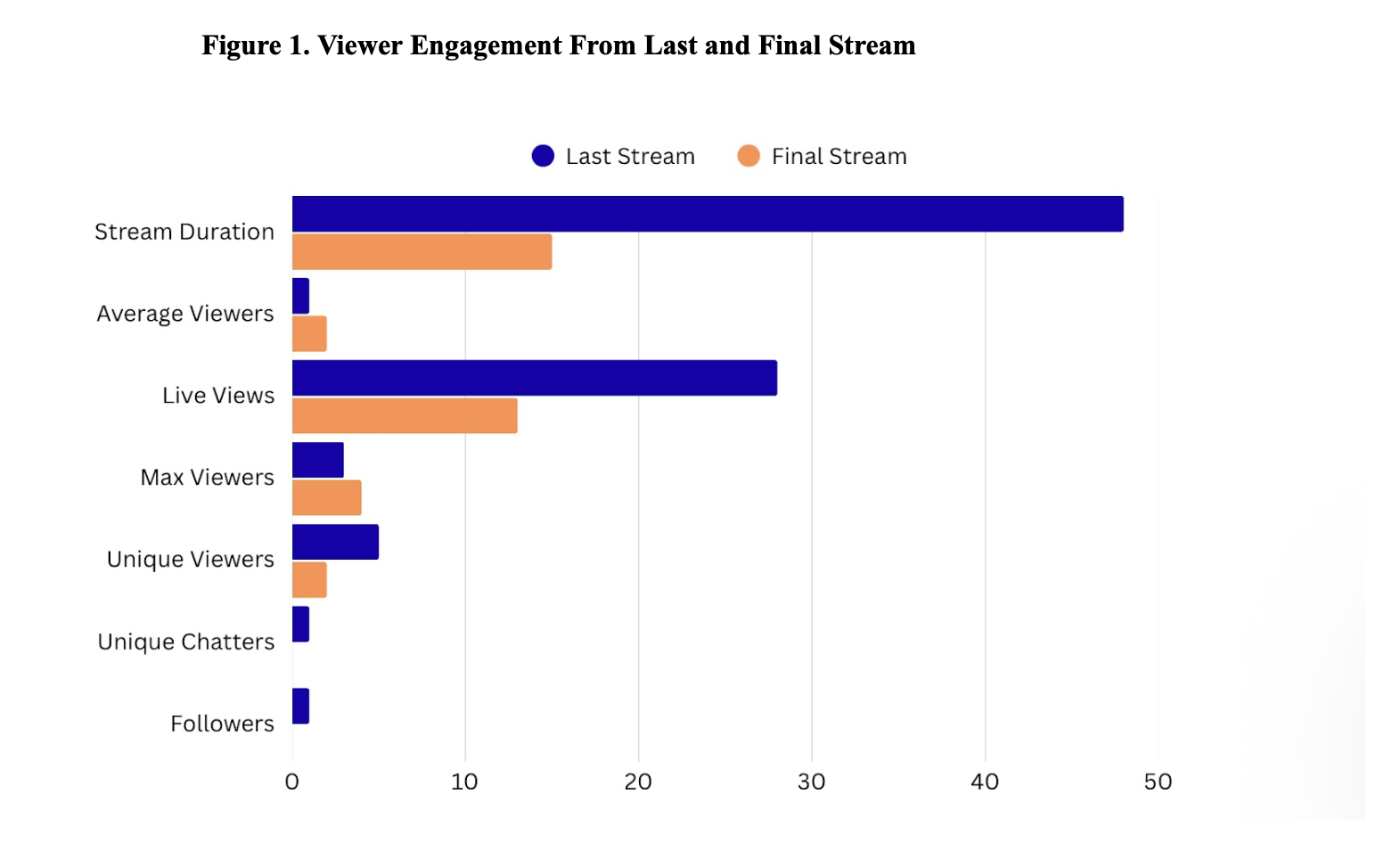
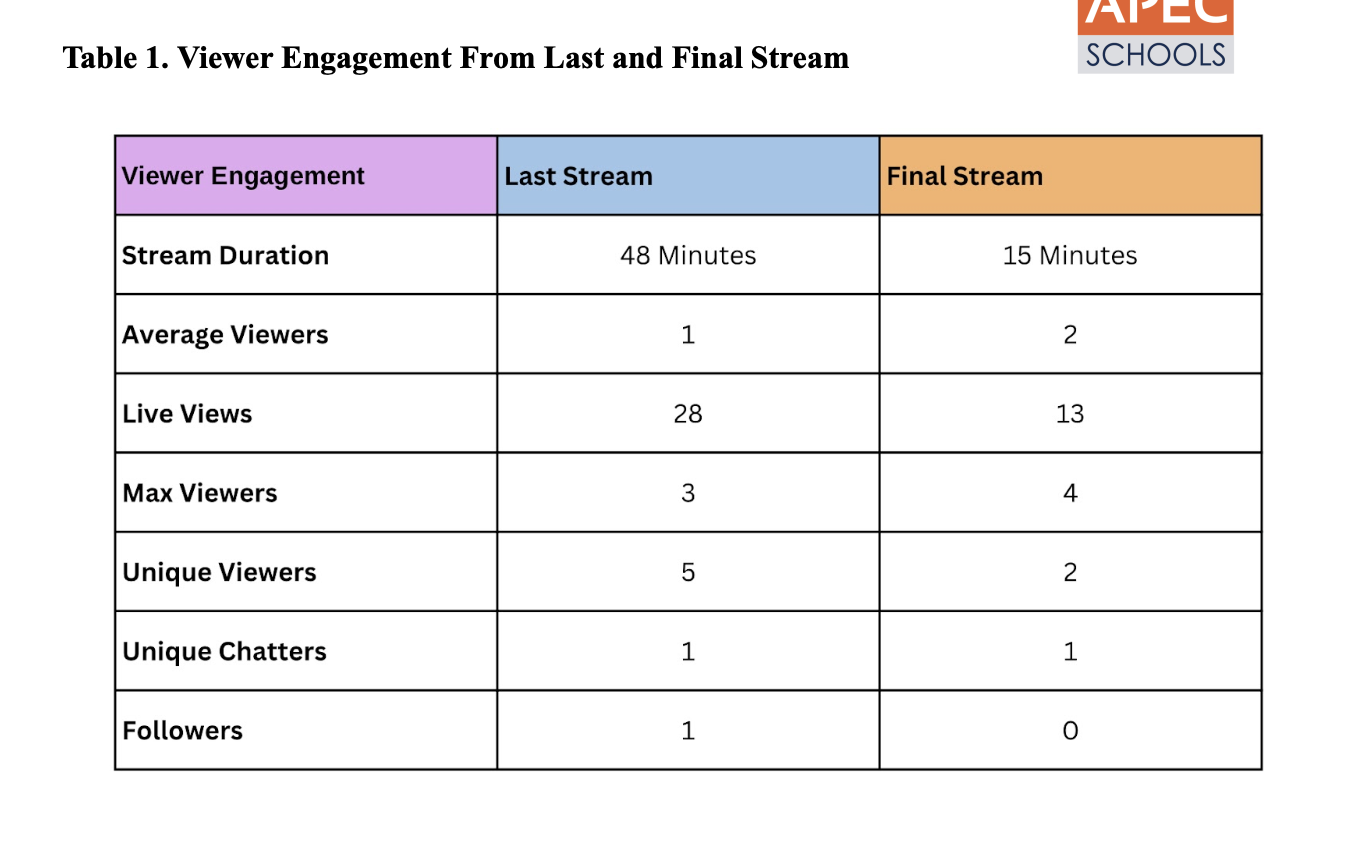
The amount of viewers present during the stream remained a lower average, but was around the same amount as the last few trial streams despite multiple promotional materials used and sent out. The average viewer amount throughout the
stream(s) remained around 4 viewers.
Due to the previous stream, the members have been able to form a comparison graph based on the information collected from both streams. The changes between both streams can be seen and are very evident. Some aspects of both streams can be seen to be higher or longer, while some are lesser or shorter.
Based on research and insights of members, the amount of viewers averaged on the stream is not uncommon, but in fact, is very common for streamers starting out. Most average around the same amount of viewers, some even staying at 0.
The engagement present in the stream was mostly between the two speakers, with the goal of making the stream more like watching a show. After a brief discussion between the members of the group, a conclusion was formed that in order to get more viewers, more engagement with the audience was needed.
In conclusion, although the amount of viewers remained a lower average, it is not uncommon, but is a rather noticeable pattern amongst newer streamers. Some aspects of both streams increased, meanwhile some decreased. In order to increase the viewer aspect, more audience engagement should be present.
Viewership:
This section focuses on identifying the potential causes why our Twitch livestream is experiencing low viewership. One of the significant causes of low viewership is the limited duration of podcasts which only lasted 15 minutes, leading to waning audience engagement and interaction.
Other than that, the livestream was not promoted effectively. This resulted in unawareness and shortened participation for the entire livestream podcast, as the email invitation for the students was sent last minute before the livestream started.
Appendix
| THE LIGHTKEEPERS: MEMBERS |